
Monday Morning Musings
Volume XXIV, Number 31 (Issue 1192) August 3, 2026
Battling Complacency – Part II: Connections and Actuators
The Work
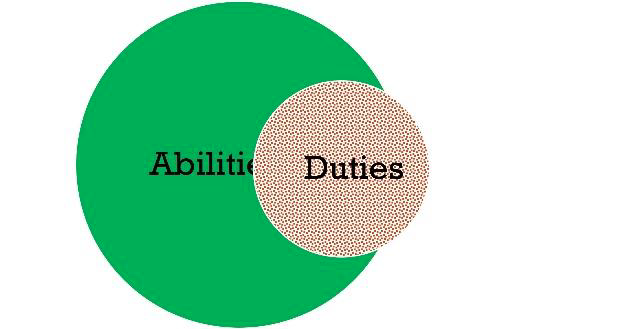
There are a number of things that factor into our work and workday that can either cause or reduce the risk of complacency. For example, consider the Venn Diagram (Figure 1) below. Here the green circle represents an individual’s abilities – that is, the totality of their personality, God-given talents, education (both formal and informal training), and experience. The red circle in Figure 1 represents an individual’s job duties. In a situation such as this where the individual is capable of doing so much more than is required of them, the likely outcome is boredom and eventually, complacency. The individual is not sufficiently challenged. As a general rule you and I enjoy learning new things and finding opportunities for personal and professional growth. Absent that at work, abilities not being utilized on the job will seek other outlets, be it through our hobbies, socializing with friends, volunteer efforts, etc.
Figure 1
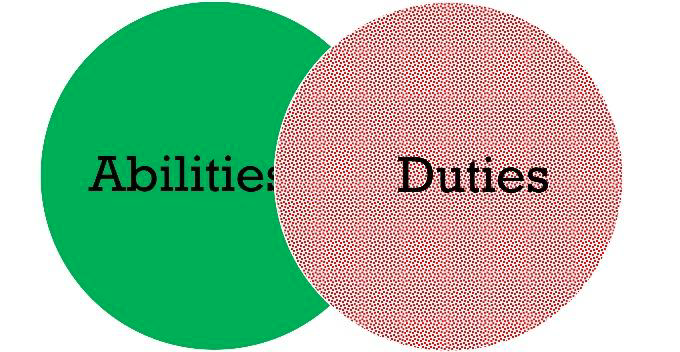
Now consider Figure 2. In this diagram, the individual’s duties (illustrated by the red circle) are not a good match with their capabilities (the green circle). In fact, there is limited overlap. The inevitable result of this set of circumstances is the individual is going to fail repeatedly not to mention feel inadequate. Soon enough they will become frustrated as will their boss and teammates. Furthermore, the quality of services they render to both the internal and external customer is going to fall short of expectations. In short, this individual is a poor fit for the job. This mismatch might have been detected in advance had the organization done a better job of vetting – more about that in a minute.
Figure 2
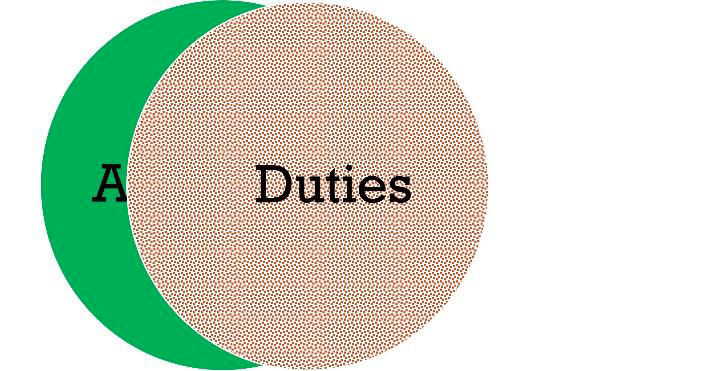
Finally, take a look at Figure 3. This diagram illustrates the situation where there is a good overlap between abilities (the green circle) and duties (the red circle). A one hundred precent match is out of the question since no set of abilities will perfectly align with one’s duties. But with this relationship the individual is likely to find they are challenged – in a good way – on a regular basis. When, as a leader, you encounter this situation it is likely the employee will benefit from feedback, focused training, coaching, mentoring, and some goal setting. For the employee, career growth seems very attainable and therefore motivating – particularly when career path options can be well defined.
Figure 3
It is important to remember that a bad hiring/promotion decision is very expensive. So too is the cost associated with an under-employed individual –since their complacency impacts others’ morale and performance.
I previously made mention of the value of vetting hiring and prospective promotion decisions. Among the numerous tools available that provide insight into an individual’s personality and likely fit one finds Myers-Briggs, the DiSC Profile, the Predictive Index, Strengths Finder 2.0, and more (SF2 is our preferred assessment tool). There are also certain well-crafted open-ended questions that can aid in the hiring/promotion process. It is said a promotion is evidence one is very good at the job they are leaving; however, it is no guarantee they will succeed in their new role.
Next week we will look at the role of teammates and teamwork when it comes to battling complacency.
Soli Deo Gloria
“…to bestow on them a crown of beauty instead of ashes, the oil of joy instead of mourning, and a garment of praise instead of a spirit of despair…” Isaiah 61:3
J. Keith Hughey
Mobile: (210) 260-0955
E-mail: keith@jkeithhughey.com
Website: www.jkeithhughey.com
Transforming Potential into Unmatched Performance
Copyright 2026 by J. Keith Hughey. All rights reserved. Permission is hereby granted for reproduction and redistribution of this essay as provided under the copyright laws of the United States of America. Recent issues of Musings may be found at www.jkeithhughey.com. Your comments are both welcomed and encouraged.